What is the point of "Smart Bridges" if it's not "smart" enough to know that the M200 is capable of bridging a 2.4mm dia hole?
3805
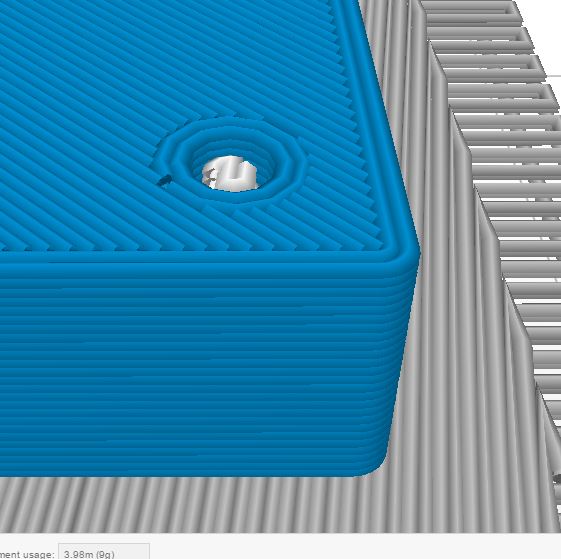
It would be a great feature if it actually worked.
What is the point of "Smart Bridges" if it's not "smart" enough to know that the M200 is capable of bridging a 2.4mm dia hole?
3805
It would be a great feature if it actually worked.
yup they need to step up the support options...or ultimaker 3 will be my next 3d printer instead of a new m200..
Have to admit that SB is 'bit' bugged.
Can I get that STL, please?
Needs to be printed in this orientation due to design criteria. Getting the main support out is OK, but getting support out of the 2.4mm holes is too difficult, and should be unnecessary.
Needs to be printed in this orientation due to design criteria. Getting the main support out is OK, but getting support out of the 2.4mm holes is too difficult, and should be unnecessary.
https://cloud.zortrax.com:444/index.php/s/qfulTh0St9xJXHO
SB: ON, support inside holes is gone.
ps. out of curiosity, you can compare top layer of both zcodes after printing (yours and mine)
I get a 403 Forbidden error when I click your link so I can't see what you did differently. Maybe it's a 1.7.1 vs 1.6.1 issue, as I'm using the latter?
Thanks.
I get a 403 Forbidden error when I click your link so I can't see what you did differently. Maybe it's a 1.7.1 vs 1.6.1 issue, as I'm using the latter?
Thanks.
I was using 171 and Test version, zcode has been made using test one.
Maybe a noob question, but what is the design criteria to print it this way?
If you turn it upside down, you dont have support and less material.
The after you print it, use a heat gun to get the white bottom smooth and it is finished?
Maybe a noob question, but what is the design criteria to print it this way?
If you turn it upside down, you dont have support and less material.
The after you print it, use a heat gun to get the white bottom smooth and it is finished?
Even if you use a heat gun on the bottom surface, it will never be anywhere near as nice-looking as a top surface. This particular part needs to look really good on that surface.
I get your frustration—when a feature is called “Smart,” you expect it to actually recognize common cases like a 2.4 mm hole without needing manual tweaks.**
In practice, a lot of these “smart” bridge tools rely on preset thresholds or conservative assumptions, so they don’t always detect smaller or borderline features correctly. That’s probably why it’s not bridging the hole automatically.
It would definitely be a solid improvement if the system could adapt based on tool capabilities (like the M200) or at least allow more granular control over detection limits.
For now, the only real workaround is adjusting the settings manually or forcing the bridge where needed—but yeah, I agree, this is exactly the kind of thing the feature should handle on its own.